
Flava
Adding Boost - a lightweight growth mechanic that helps users get noticed and helps the product monetize attention
Flava
Adding Boost - a lightweight growth mechanic that helps users get noticed and helps the product monetize attention
Flava
Adding Boost - a lightweight growth mechanic that helps users get noticed and helps the product monetize attention
Context
💗 Flava is a dating app with a strong focus on anonymity and communication safety, offering core dating features for free and advanced functionality through a paid subscription
Like most dating platforms, it faces a structural imbalance: there are significantly more male users than female users. As a result, many men get very few profile views, matches, or replies. Over time, this leads to frustration, self-doubt, and disengagement.
Boost was introduced to address this reality — not by promising better outcomes, but by offering more visibility at moments when users feel invisible.
Like most dating platforms, it faces a structural imbalance: there are significantly more male users than female users. As a result, many men get very few profile views, matches, or replies. Over time, this leads to frustration, self-doubt, and disengagement.
Boost was introduced to address this reality — not by promising better outcomes, but by offering more visibility at moments when users feel invisible.
Problem
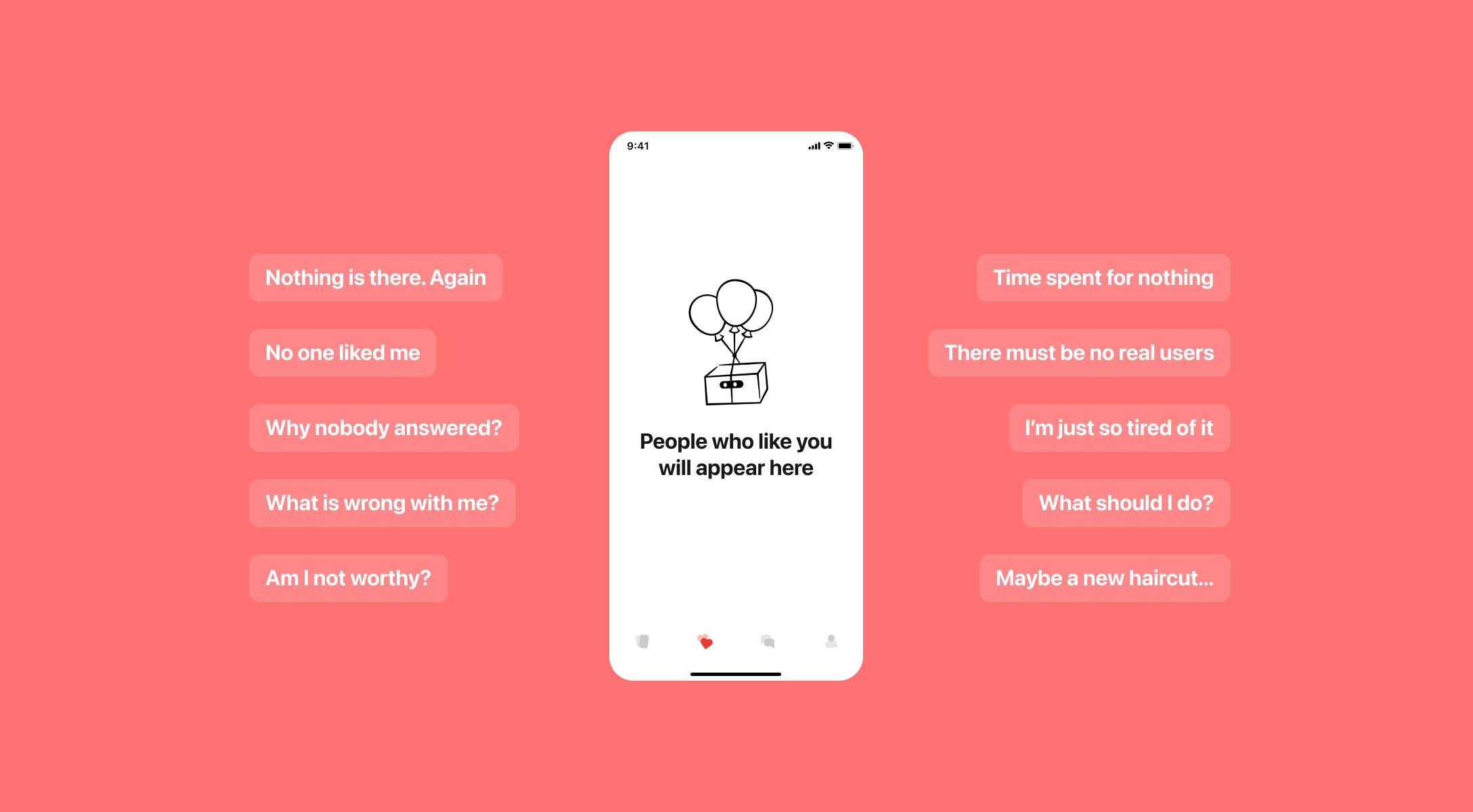
I’ve spent time swiping. I liked people. And nothing happened
I hear it from my friends, I hear it during research, and I hear it whenever people around me talk in cafés. Silence feels personal. And over time, that feeling becomes heavier than rejection. You take action, yet get nothing in return.
From the product side, this showed up as:
- users losing motivation
- declining engagement
- a sense that free usage had little value
💡
We needed something that give users a sense of agency, activate them instead of letting them drift away and add value without breaking trust.
Goals
- increase % of matches and user engagement
- keep users active inside the app and improve retention D3 & D7
- add additional monetization mechanic that makes premium looks more valuable
At the same time, there was an important secondary goal: not turning dating into a full pay-to-win experience.
Even without strict technical constraints, a lot of time went into discussing how the new mechanic should feel emotionally, not just functionally. One thing make it feasible and another engaging
Research
Before designing Boost, I needed to understand one key thing: who actually uses dating apps — and why they keep coming back.
Instead of starting with assumptions, I looked at how people talk about dating when no product team is listening. I also explored basic dating and habit-formation psychology, research on social validation, and how attention works as an emotional reward — especially in environments with low feedback and high competition. This helped me move beyond metrics and better understand the emotional context of the product.
Where I looked for insights:
- Flava product analytics (gender, age, etc)
- Reddit (dating, Tinder, Bumble, male/female dating experiences)
- Social media (Facebook, Instagram, Youtube): posts, videos and comment sections around dating fatigue and burnout
- Psychology books about habit forming (Hooked, Attached)
- Resent research on dating behavior on Pubmed
- Reviews on App Store
- 5 qualitative user interviews (2 men, 3 women, all actively dating at that time)
Who the most active users are
- male, 23–35 years old
- living in large or mid-sized cities
- open to connection, but increasingly cautious
For many of them, dating apps were no longer about finding “the one”. They were about staying visible, relevant, and chosen, even temporarily. Many users weren’t opening dating apps to meet someone that day.
Users motivation
The more I've worked on my research the more I've seen the reccurent behavior pattern. Users tended to go for validation over outcomes. Meaning users weren’t opening dating apps just to meet someone that day.
💡
They wanted to be seen and feel attractive — and for granted
+ get quick emotional feedback (or dopamine boost)
This often resulted in short, dopamine-driven sessions rather than long-term engagement. This are the quotes I get from my user interview that proved that statement:
“…honestly sometimes I don’t want a date. I just want to know I’m still desirable”
[female user of Tinder, 27 y.o.]
“I just see all those pretty girls on the main page, and I feel rejected when they don’t like me back. And when I get a like from someone I liked before, it makes my day — okay, at least my hour”
[male user of Tinder, 36 y.o.]
Competitors reserach
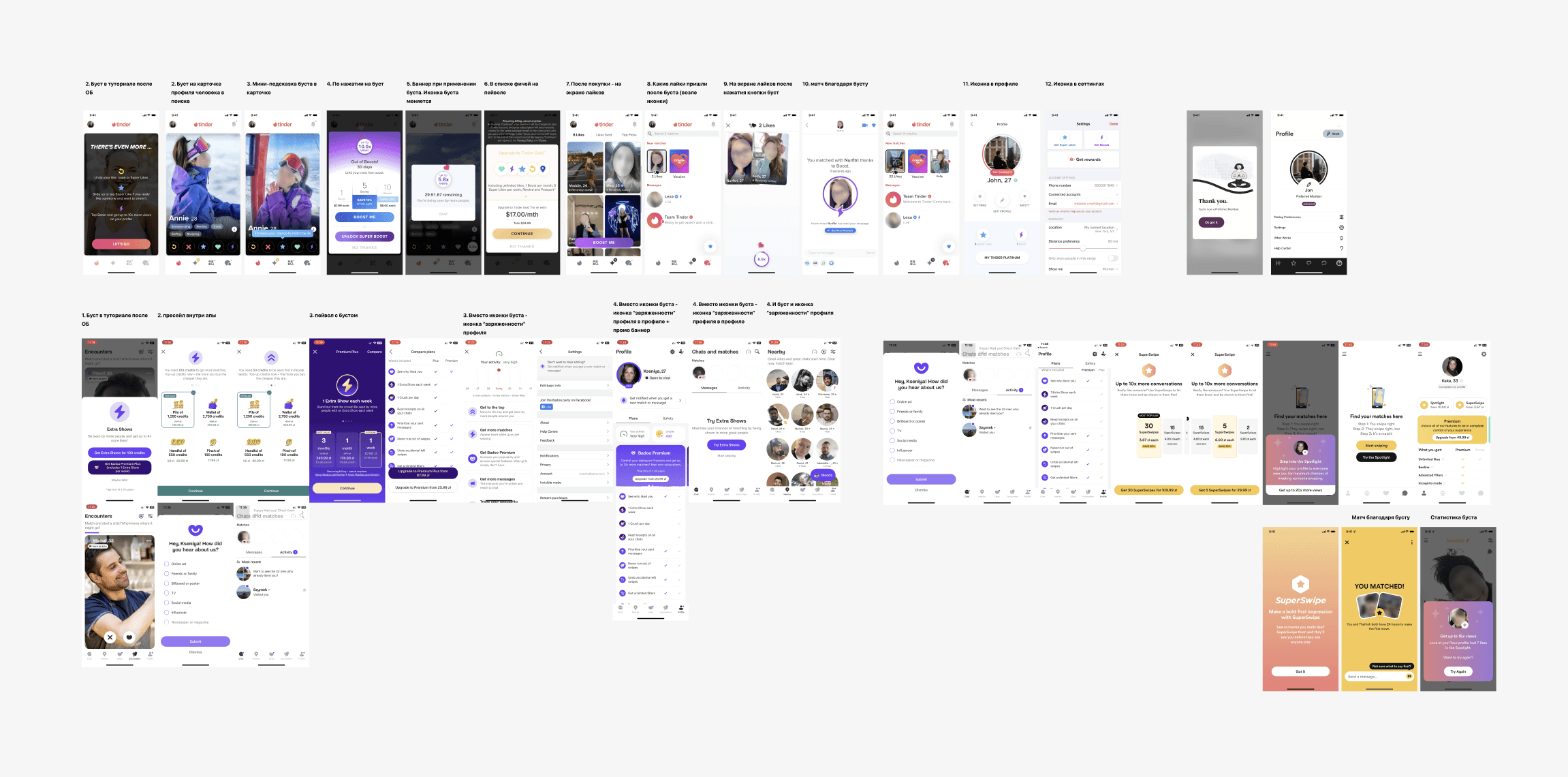
I also reviewed how similar mechanics work in other dating apps. Some, like Tinder, push Boost very aggressively. The value is clear, but the pressure is high. Others, like Bumble, take a softer approach — but the benefit feels vague and delayed.
Key Research Insights
- Silence is more damaging than rejection
- Attention is a core emotional need in dating apps
- Users want to have some control over others’ attention
- Boost mechanics are actively used across dating apps
Solution
💡
Boost is a time-limited visibility feature that helps users who are seeking attention but aren’t getting enough of it
When activated, it temporarily raises a user’s profile in search and discovery, increasing the number of impressions they get during that period.
It’s especially relevant for male users, who statistically receive fewer views and interactions — not because of quality, but because of scale.
The key idea was not to promise outcomes, but to offer opportunity.
Design
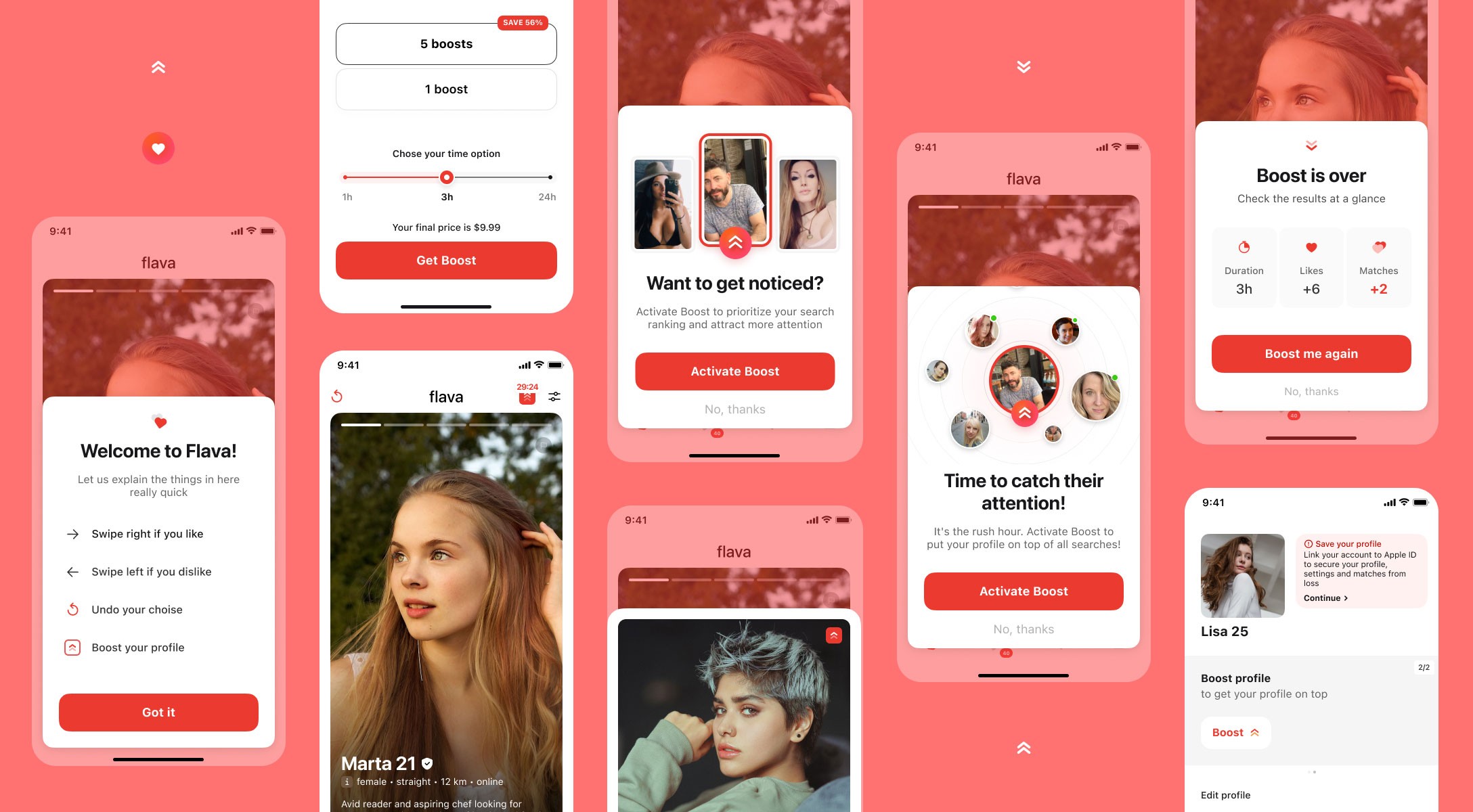
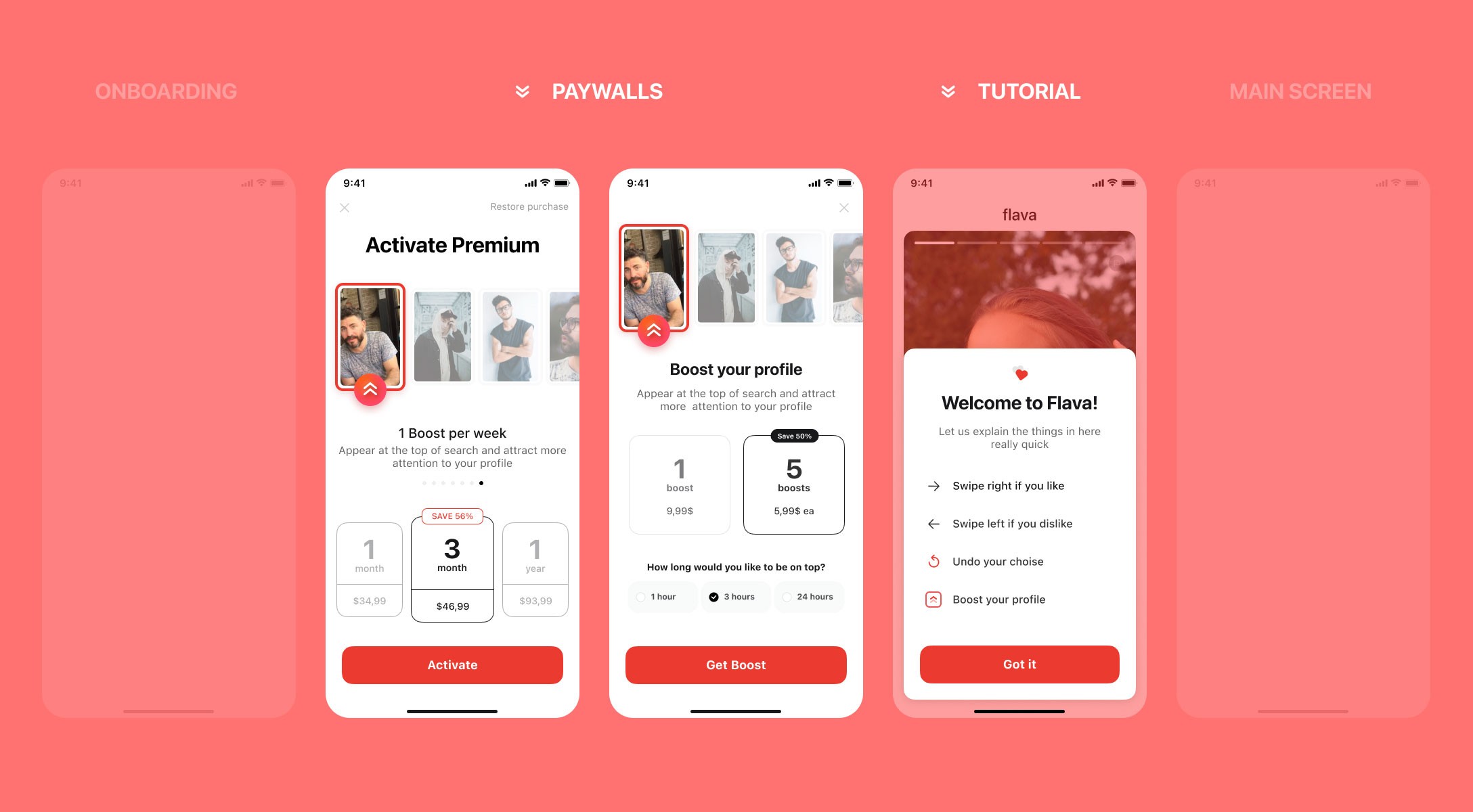
Boost is seamlessly integrated into the app through the paywall, tutorial, main screen, banners, user profile and other screens.
Boost triggers:
- Paywall
- Tutorial
- Main Screen
- Boost Result Screen
- Empty Likes Screen (no likes)
- Profile
Boost statuses and activities:
- Inactive
- Active (+ timer)
- Ended
- Match happened because of Boost
- Chat happened because of Boost
Paywall
I added a new Boost feature to the paywall and created several variants. This helped familiarize users with the feature and added extra value to the premium subscription.
Tutorial
Right after onboarding, I added a short tutorial popup to showcase the core mechanics. I intentionally presented Boost as a key feature to highlight its importance and draw attention to it. My hypothesis was that positioning Boost as a main mechanic would make it feel essential and increase engagement.
Additionally, this lightweight tutorial is simply a helpful tool for users who may be new to dating apps and could feel confused when opening the app for the first time.
Design
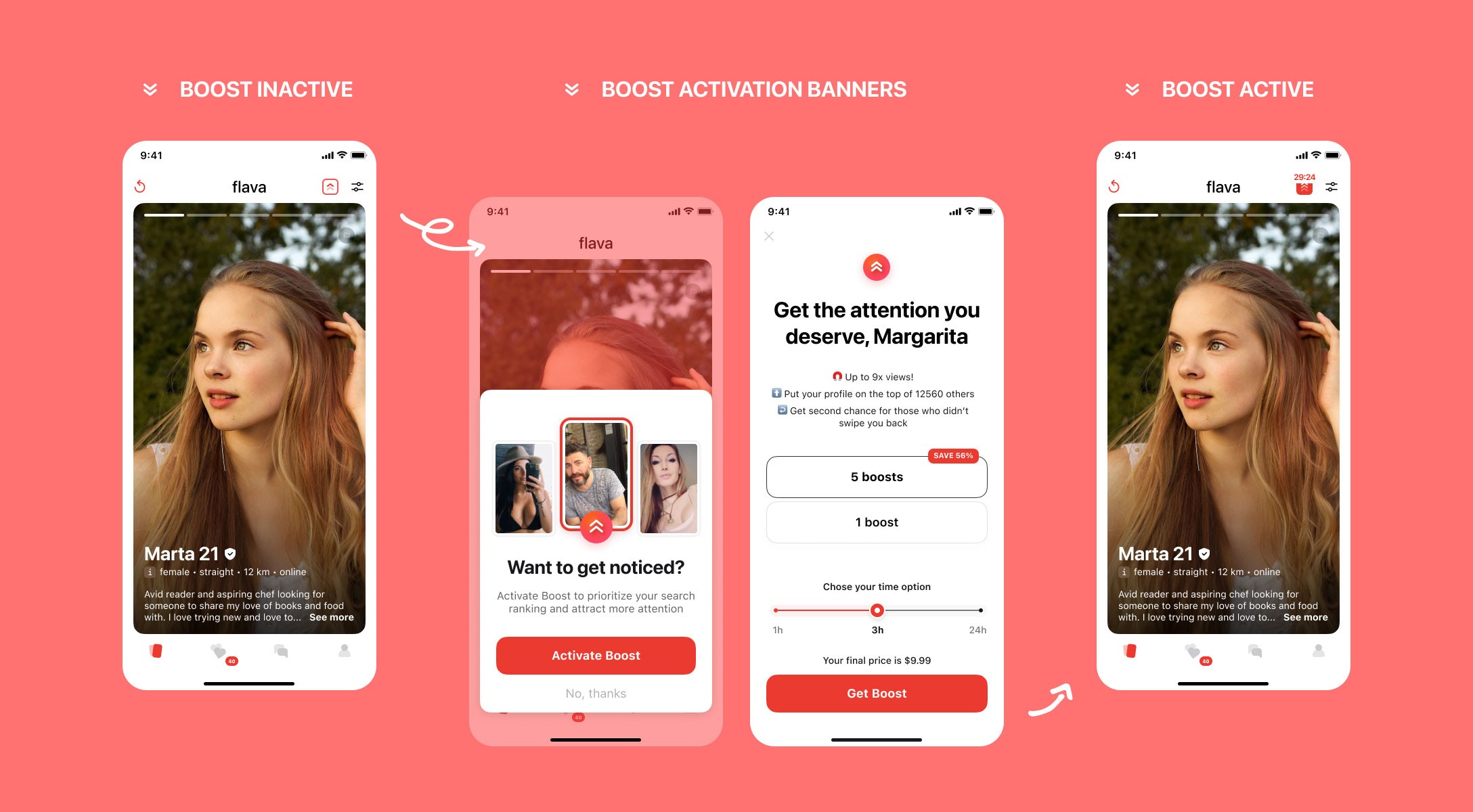
Icon on Main Screen
I added a small Boost button to the main screen that serves two purposes: activating Boost (tap the button to see the Boost purchase banner) and showing its current status. When Boost is active, the icon changes and a timer appears.
Boost Activation Banners
I placed several activation banners in different areas of the app to avoid feeling repetitive.
Design
Boost Result screen
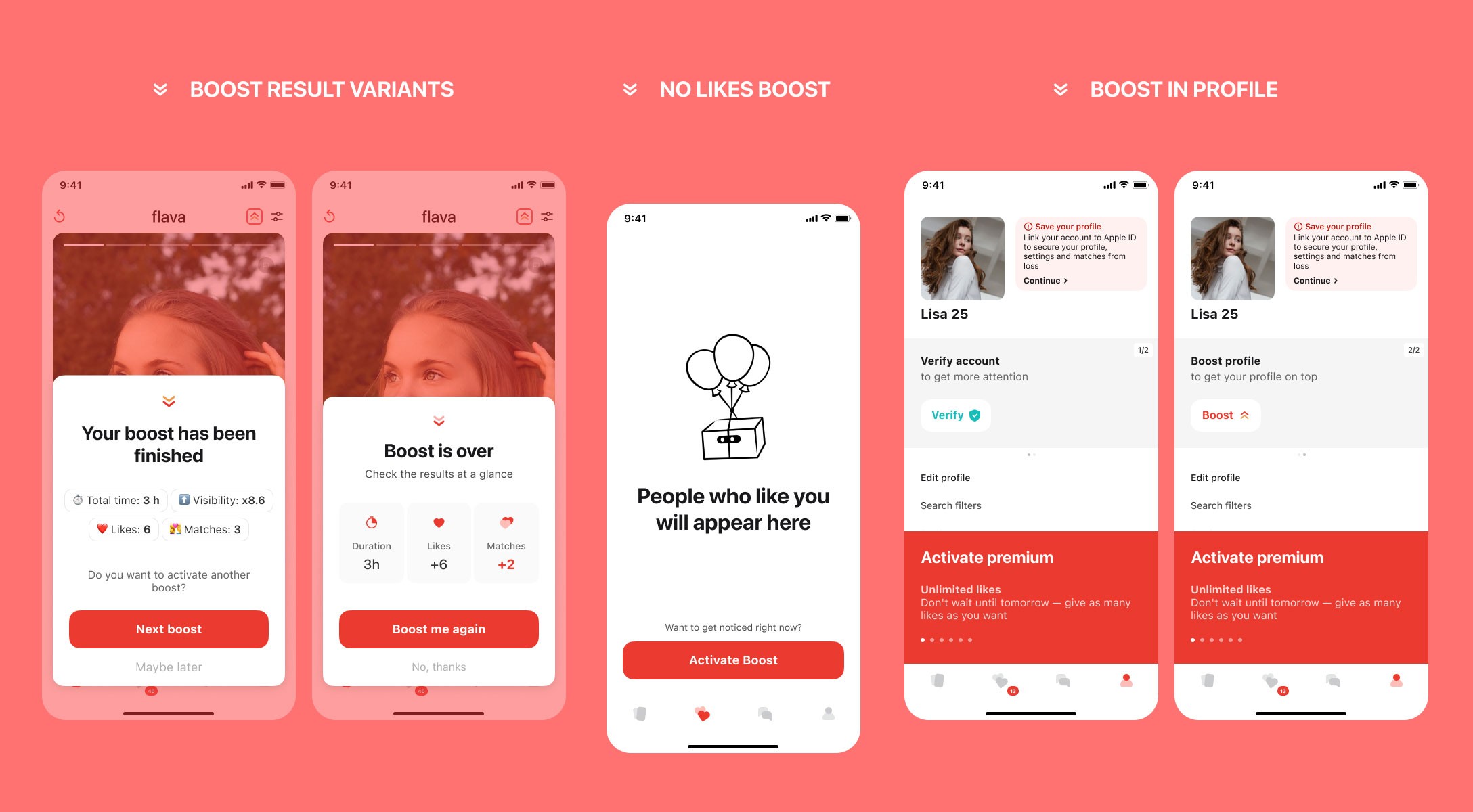
I designed the end of Boost as a results summary. My thinking was simple: if users pay for a feature, they want clear feedback on what they got in return. This screen shows how Boost performed compared to the free mode — through likes and matches received. I made sure all of this was clearly visible on the results screen, so users could easily understand the value of Boost.
Empty Likes Screen
This is a good place to offer Boost activation. Imagine a user’s frustration when seeing an empty Likes section and waiting for likes to appear. In this moment, Boost can feel like a helpful and relevant solution.
Profile Screen
Boost is also added here as a feature that can influence the success of this profile.
Design
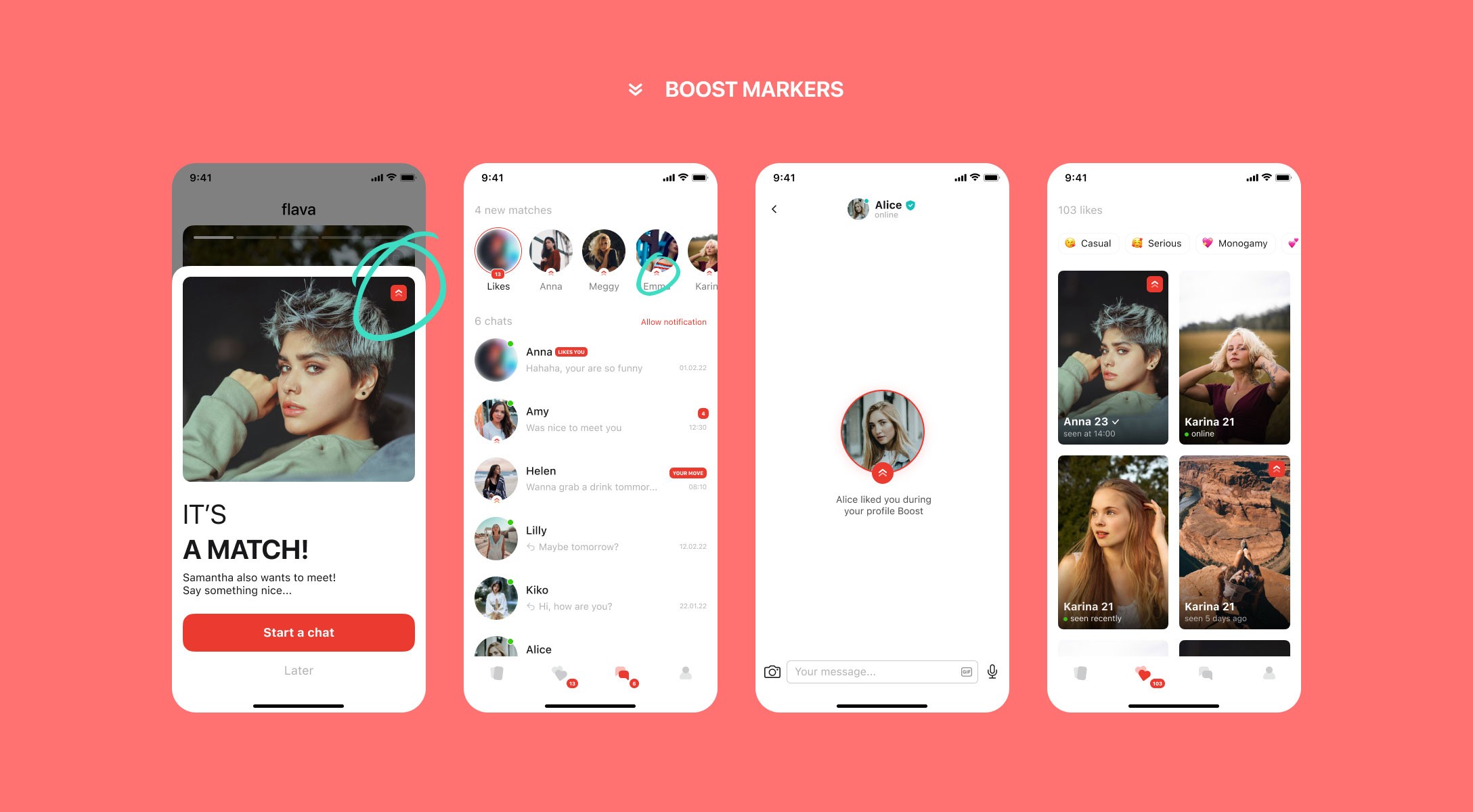
Boost Markers
It’s also important to highlight Boost where it actually makes a difference — in chats and matches. That’s why I added Boost markers (using the same recognizable icon from the main screen) to indicate matches and chats that happened while Boost was active.
Outcome
Boost was released to production and tested with real users. In the first weeks, it performed well from a monetization perspective, and I received positive feedback from the team about the feature’s success. User drop metrics were also monitored and remained stable. However, I didn’t observe a significant impact on overall user engagement. In short, monetization improved, but retention did not change much. I would have liked to continue working on this and explore ways to improve retention, but my contract with the Flava team ended around that time.
Looking at the product a few years later, I can see that the feature still exists — but it’s much less visible. The Boost icon is no longer present on the main screen. This leads me to an important takeaway: monetization features can drive quick wins, but emotional products like dating apps require constant fine-tuning to protect long-term retention and user trust. If pushed too hard, Boost may start to feel intrusive or overly commercial to users.
Retrospective
Lessons
The biggest takeaway from this project was understanding how deeply dating apps rely on psychology — and how easily they can slip from helpful to harmful.
Designing in this space taught me that sometimes the most important part of a feature isn’t how well it converts, but how it makes people feel afterward.
What I'd do differently
If I were to redesign Boost today, I would make it now more delicate and quieter. Also, I'd add more personalization, based on user's data making Boost target only specific users, not everyone.
Tradeoffs
The Flava team and I had an interesting discussion around the paywall design. I proposed creating a completely different paywall using the existing tone of voice, but making it more psychological and layered. The team preferred to stay closer to the paywall patterns they were already familiar with,. In the end, we agreed to run an A/B test with two different paywalls: one based on my concept and one following the team’s preferred approach.